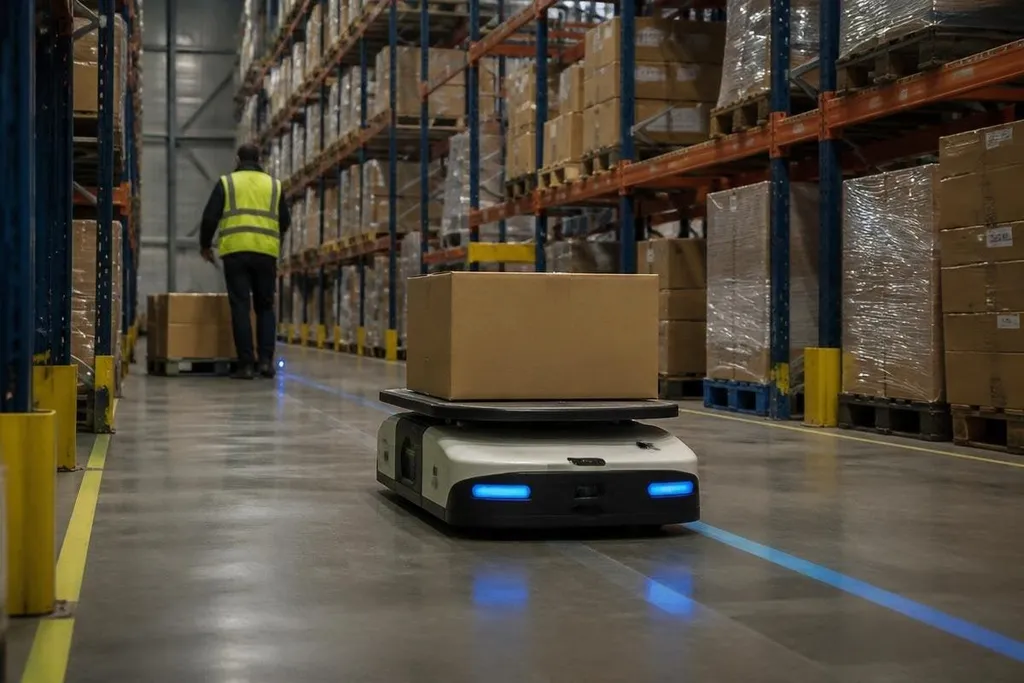
A warehouse robot can lose a race while moving at a higher top speed. The useful measure is how quickly it completes a safe task, returns to work, and keeps doing so through a shift.
- Top speed misses stops: turning, sensing, and handoffs can take more time than travel.
- Cycle time matters: measure one full task from pickup to drop-off.
- Proof needs a setting: a result in an empty test area says little about a busy warehouse.
Speed starts before the robot moves
Part of each task is spent deciding where to go. Its sensors read shelves, people, pallets, and other robots. Software then picks a path and checks whether that path remains open.
That work affects the clock. Fast travel can still produce fewer jobs if the robot stops often, while steadier movement may finish more tasks. The useful number is cycle time, meaning the time from one completed task to the next.
The task also includes pickup and drop-off. The mobile robot may reach a shelf quickly, then wait for an arm, scanner, door, or worker. Those waits belong in the result because the warehouse pays for the full task, not the fastest part of it.
The handoff decides many races
Warehouse automation often joins several machines in one flow. A robot carries a tote to a station, waits for a person or arm, then takes the tote to another location.
A delay at that handoff can erase any gain from faster driving. This is why tests should record each stage separately. Measure travel time, waiting time, pickup time, drop-off time, and recovery after a blocked path. One total figure hides the part that needs fixing.
A useful test also keeps the work the same. The robot should carry the same load over the same route while the test records completed tasks per hour. If the route changes, the result becomes hard to compare.
A speed figure needs its setting before you compare it with your warehouse work. Warehouse robotics reporting from Robot24.com can name the machine, load, route, site, and test date behind the number. That record also shows where faster movement may add battery use, wear, or staff work.
Faster movement can raise other costs
More speed can mean harder stops and larger safety zones. The robot may need more distance to stop near a person or another machine. That can reduce the number of robots a warehouse can place in one aisle.
Power use also belongs in the test. A robot that finishes more tasks but needs longer charging stops may produce little extra work across a full shift. Battery swaps, charging time, and the number of spare batteries change the result.
The load matters too. A robot carrying an empty tote can move differently from one carrying a full case. Any speed claim should state the payload, route length, floor type, number of stops, and traffic level.
I’d judge a warehouse robot by completed tasks per shift, not its top-speed figure.
What proof should look like
A useful report gives enough detail for another team to repeat the test. It names the task, load, route, traffic level, safety stops, and time period. It also says what the robot could not do.
A video can help, but it rarely answers every question. A short clip may show smooth travel while leaving out failed pickups, charging stops, remote control, or edits between actions. Those missing parts matter more than a fast pass through an empty aisle.
The strongest result connects speed to a warehouse outcome. For example, a report might show that a robot completed more tote moves per hour while carrying a stated load, with a stated number of safety stops. Without those details, “faster” has little use for a buyer.
Use this before you compare
Check the test on five points:
- Task definition: write down the start and end of one completed job.
- Payload record: state the load in kilograms, including the container.
- Route conditions: note distance, turns, floor surface, doors, and traffic.
- Downtime log: count charging, blocked paths, failed pickups, and remote help.
- Shift result: compare completed jobs across the full working period.
This checklist keeps a speed claim tied to work you can count. It also shows where a robot may need changes to layout, software, charging, or staffing.
The race will be decided by the robot that completes more safe work across a shift. Until a company publishes the task, load, route, downtime, and full test period, its top-speed number is only one part of the purchase decision.